

Workspaces and dispatch
SRC bounty
Integrated workbench for long-term bug bounty and vulnerability research: main research conversations, managed egress proxy and isolated browser containers, asset/traffic analysis, evidence-bound findings, and bounty ledger.
On this page
1. Workbench overview#
The SRC bounty workbench (/src) is built for multi-day or multi-week vulnerability research where context, traffic samples, assets, and report drafts must evolve together inside one workspace (/src/tasks/<task_id>):
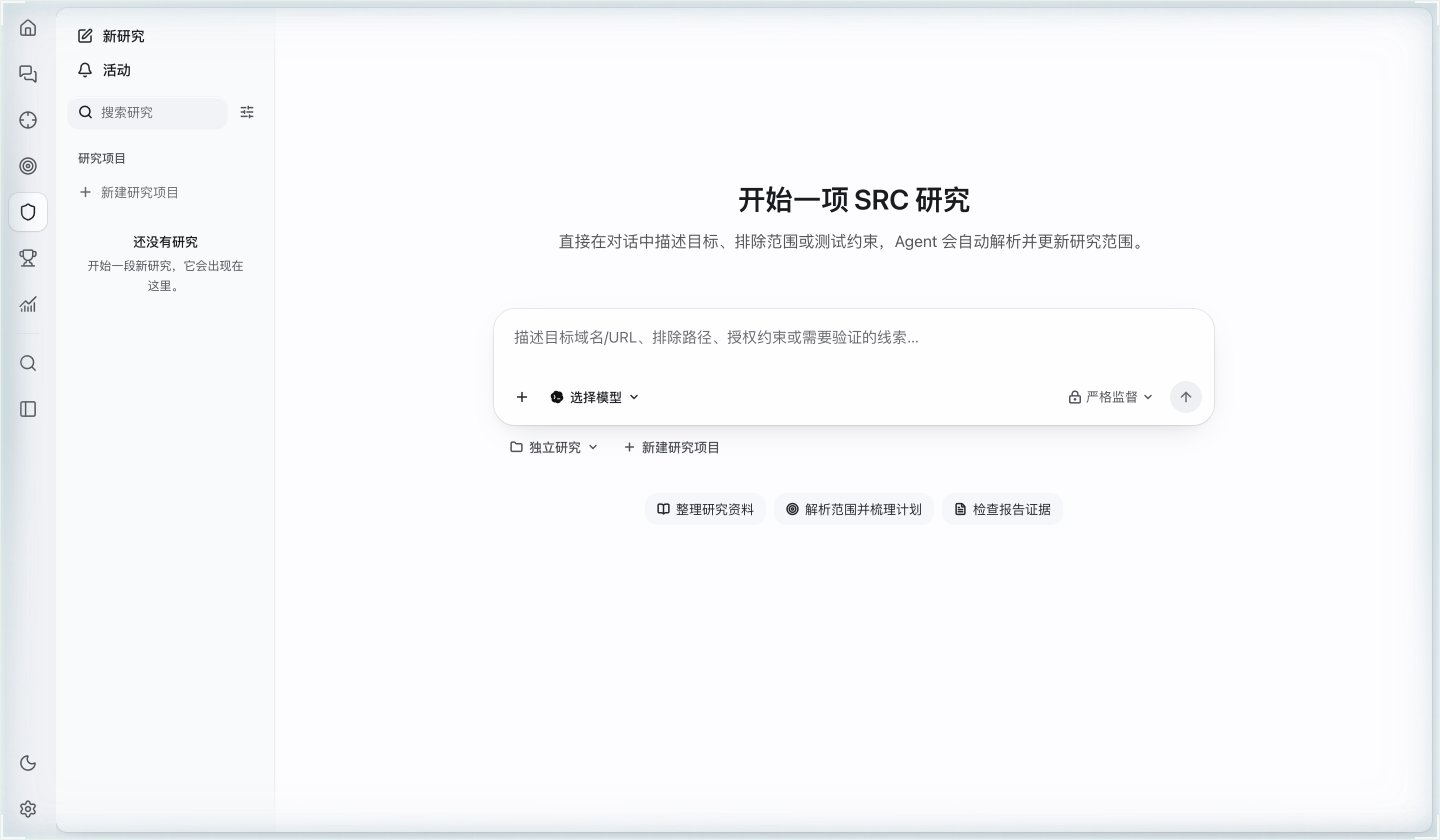
- Main conversation driven research: State targets, scope rules, and reference material in one continuous research conversation spanning recon, request signing, verification, retesting, and writeup drafting.
- Historical research & takeover: Browse past read-only research projects or explicitly take over an older session to continue investigation.
- Dedicated SRC orchestration override: Under Settings → Orchestration (
/settings/orchestration), switch to the SRC tab to configure a separate multi-agent model roster specifically for bounty research without affecting regular Coding Chat.
2. Core functional areas#
| Module | Purpose & capabilities |
|---|---|
| Scope & policy versions | Track authorized domains/URLs/IPs and excluded_targets with digest-pinned versioned policy snapshots enforced on egress and retests |
| Assets & sources | Import asset lists or connect external data feeds while tracking observation provenance and entity ownership |
| Traffic analysis & diff | Search captured HTTP exchanges, inspect payloads manually, compare pairs, and iterate on custom request-signing drafts |
| Tasks & Todo board | Track research plan versions, todos, linked sub-runs, and monitoring jobs |
| Findings & evidence links | Bind each vulnerability finding directly to raw captured traffic and execution artifacts for instant auditability |
| Report drafts & bounty ledger | Draft vulnerability reports, freeze final snapshots prior to submission, and record vendor triage status, retests, and bounty payouts |
3. Managed isolation containers and runtime dependencies#
To enforce scope boundaries while analyzing complex web targets, SRC relies on three isolation components when Docker and host sandboxing are available:
- Managed egress proxy gateway (
muteki-src-egress:latest): Automatically built and updated by the Rust server fromdocker/src-egress/(keyed bymuteki.src.source_digest), combining Alpineiptables/ip6tableswith a dual-layer HTTP/HTTPS proxy to enforce target allowlists, block excluded targets, rotate upstream proxies, and record HTTP traffic. See Docker containers and images. - Controlled browser container (
muteki-src-browser:latest): Auto-built fromdocker/src-browser/(Node + Chromium +agent-browser) and wired behindmuteki-src-egressso interactive browser testing never bypasses scope controls or leaks host browser state. - JS request signer sandbox (
bubblewrap): Executing custom JavaScript request signers requiresbubblewrap(bwrap) and Node.js with--permissionsupport installed on the host. If sandboxing is unavailable, Muteki fails explicitly instead of running untrusted signers unsandboxed.